Impala Escape Code!

Mason O'Donnell
| 27-07-2026
 · Animal Team
What's Up, Friends! Imagine standing on the savanna when a sudden movement in the grass triggers an impala's instant escape.
This reaction may seem simple, but it involves a complex system of vision, hearing, muscles, and especially the brain.
The impala’s brain quickly processes information and guides its body with incredible speed to navigate the challenges of the wild.
An impala does not have time to carefully analyze every threat. When a lion, cheetah, or wild dog approaches, its brain must rapidly collect information, predict danger, and choose the best escape strategy. This remarkable decision-making process helps explain how impalas survive in some of the most challenging environments on Earth.
Why do male seahorses carry hundreds of tiny babies? Their underwater journey defies expectations!
No bamboo, no red pandas? The answer may surprise you!
A spotted cat swimming through deep water? For jaguars, rivers are a natural part of everyday life!
A scratched trunk isn't random! What secret message does it really leave behind?
Purple Sunbird: The Iridescent Wonder That Transforms Every Spring in South Asia
What are bears doing after sunset? The answers may surprise you!
The Brain Begins With Constant Threat Monitoring
Life on the open grasslands requires constant awareness. Impalas spend much of their time feeding, but they rarely become completely relaxed. Their survival depends on detecting predators before an attack begins.
The first step happens through sensory monitoring. Large eyes positioned on the sides of the head provide a wide field of view, allowing impalas to detect movement across much of their surroundings without turning their heads. This is especially useful in open habitats where predators can approach from different directions.
Their ears also play an important role. Impalas can rotate their ears independently, helping them locate unusual sounds such as footsteps through dry grass or the movement of a hidden predator. These signals are quickly sent to the brain, where they are compared with previous experiences. A shadow moving differently from the wind or an unfamiliar sound may be enough to trigger an alert response.
The Brain Quickly Determines the Level of Danger
Not every unusual movement means an immediate attack. A bird flying nearby, another impala running, or a falling branch should not waste valuable energy by causing panic. The brain must separate harmless events from genuine threats.
When sensory information suggests danger, regions of the brain involved in rapid decision-making activate the body's emergency response. Stress hormones increase heart rate, muscles receive more oxygen, and the animal becomes prepared for sudden movement.
This process happens extremely quickly because waiting too long can be fatal. A predator such as a cheetah can accelerate rapidly, meaning an impala may have only seconds to react. The brain does not calculate escape in the same way a human plans a route on a map. Instead, it uses a combination of instinct, memory, and immediate environmental information to select the safest option.
Choosing the Best Escape Direction
Running away is not simply about moving as fast as possible. The direction an impala chooses can determine whether it survives. Predators often rely on straight-line speed and powerful acceleration. Cheetahs, for example, are among the fastest land animals, but they struggle during longer pursuits because of the energy required for extreme speed. Impalas use different strategies to avoid capture.
Their brains evaluate nearby terrain, the predator's location, and the movements of other herd members. Instead of always running directly away, an impala may suddenly turn, jump sideways, or change direction repeatedly. These unpredictable movements make it harder for predators to anticipate their path.
This ability is supported by the impala's exceptional agility. Their nervous system coordinates rapid signals between the brain and muscles, allowing quick turns and explosive jumps without losing balance.
Memory Helps Impalas Make Faster Decisions
An impala's escape response is not based only on immediate reactions. Experience also shapes future decisions. Young impalas learn from older members of the herd by observing warning behaviors. They gradually recognize which sounds, movements, and locations are associated with danger.
For example, a herd that frequently encounters predators in a certain area may become more cautious there. Over time, individual experiences and group behavior improve survival chances. This type of learning is especially important because predators do not always behave in predictable ways.
A lion hiding in tall grass requires a different response compared with a cheetah approaching at high speed across open ground. The impala's brain combines stored information with current signals to improve its reaction.
The Herd Creates a Living Safety System
An impala does not survive alone. Herd behavior adds another layer of protection. When one individual detects danger, it may alert others through body movements, sounds, or sudden changes in behavior. A single impala looking toward a suspicious area can cause an entire group to become alert.
Large groups also create a confusing target for predators. When many animals begin moving at once, predators must decide which individual to chase. This uncertainty can provide valuable time for escape. However, herd living requires coordination.
Each impala must react quickly while avoiding collisions with nearby animals. The brain's ability to process movement, spacing, and direction becomes essential during these chaotic moments.
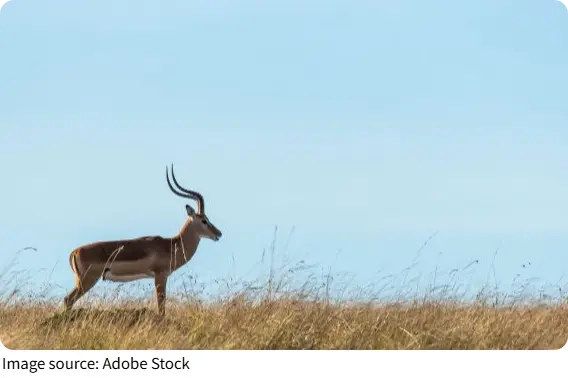
The Science Behind Their Survival Strategy
The impala's escape ability represents millions of years of adaptation. Their survival does not depend on having the strongest body or the fastest sprint. Instead, they combine sharp senses, rapid neurological responses, flexible movement, and learned behavior.
Scientists studying animal behavior continue to examine how prey species make split-second decisions because these mechanisms reveal how animals balance speed, energy use, and survival. Understanding these systems also provides insight into how wildlife responds to changing environments and increasing human activity.
An impala's escape may appear like a simple jump across the savanna, but every movement is the result of an incredibly efficient survival process. Its brain constantly gathers information, evaluates threats, predicts danger, and controls precise movements within moments.